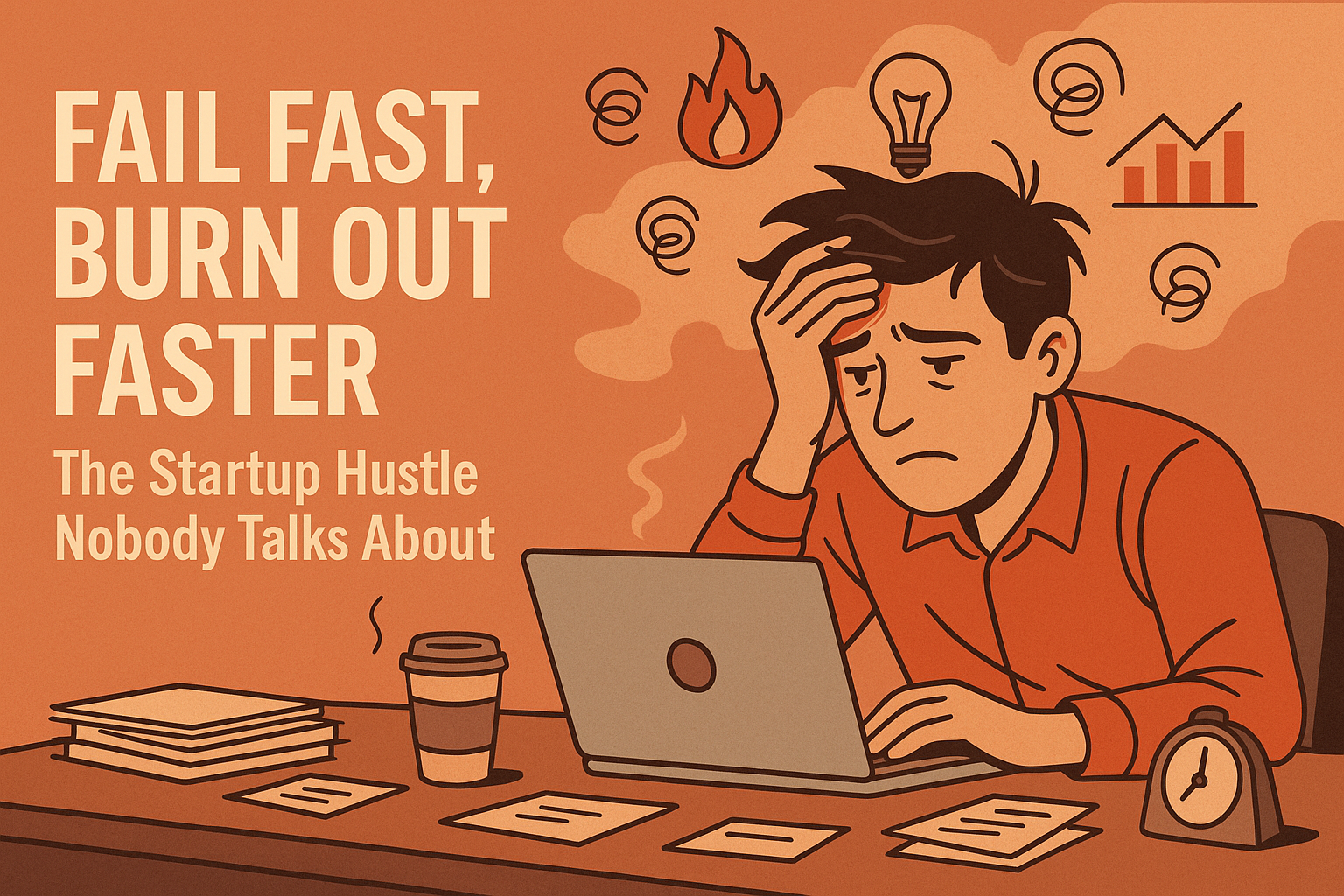
You hear it everywhere in startup circles: “Fail fast. Learn faster. Move on.”
It sounds sharp, confident — like a mantra carved into the walls of co-working spaces and seed-round pitch decks. The idea is simple: the faster you screw up, the faster you can fix it, right?
But here’s the part that rarely makes it into the conversation: what if failing fast actually just leads to burning out faster?
I’ve been part of that scene.
The 12-hour days that stretch into nights. The weekends that disappear into “just one more sprint.” The product launches that feel like the Super Bowl, only to realize the market doesn’t care. And the worst part? You have to get up and do it all over again — with less energy and more pressure.
No one tells you how lonely it gets.
Because despite all the talk of collaboration and team spirit, startup culture often isolates you. You’re supposed to always be “on,” always grinding, always pivoting. Vulnerability? That’s for after the exit — not during the seed stage.
What I remember most isn’t the pitch meetings or the product roadmap, but the emptiness I felt on Tuesday mornings. The caffeine shakes. The endless notifications. The strange guilt I had when I wasn’t working — as if taking a full day off meant I didn’t care enough.
I wasn’t alone.
Everyone I knew in the startup space had their version of this story.
One friend ran a SaaS platform and used to sleep with his laptop open. Another raised $300k, hired too quickly, lost focus — and then had to lay off half the team before Christmas. No one wanted to talk about it publicly. It’s always “we’re still iterating” or “it’s just a learning phase.” But behind the scenes, we were quietly falling apart.
The “fail fast” culture doesn’t account for people. It treats them like code: modular, fixable, replaceable. And while you can rewrite software, you can’t just reboot someone’s mental health after months (or years) of chronic stress.
Of course, not all startups are toxic.
Some teams have balance, some founders actually sleep, and some investors know the difference between ambition and self-destruction. But they’re the exceptions — not the rule.
So why do we still glorify this pace?
Maybe because slowing down feels like failure.
In a world where everyone’s tweeting wins and LinkedIn is a never-ending brag reel, no one wants to admit they’re tired. So we keep sprinting, hoping we’ll eventually reach that magical milestone where rest becomes allowed.
But here’s the truth:
If you don’t build rest into the process, your body will eventually shut you down anyway.
And no funding round, no press mention, no clever growth hack is worth trading your health for.
Failing fast might work for products.
But humans need time.
Time to process. Time to learn. Time to breathe.
So if you’re in it right now — if your calendar’s full but your head is heavy — take a moment. Close the laptop. Go for a walk. Text a friend.
Because real innovation doesn’t come from burning out.
It comes from showing up with energy, with clarity — and yeah, sometimes with coffee, but not with exhaustion as a badge of honor.
It’s okay to build slower.
It’s okay to protect your focus.
It’s okay to fail thoughtfully — not just fast.
That’s not weakness.
That’s the kind of resilience you actually can scale.